

According to the World Health Organization, about 1.3 billion people worldwide suffer from some kind of disability. That means that one out of every six people around the globe has a problem — and for much of its history, fashion designers catered to the needs of the other five. Regular clothes are created on the assumption that overhead dressing is possible, that both hands can be used, that the individual has enough grip strength, and that the body is upright. However, these assumptions do not hold for a large percentage of the world population.
Adaptive clothing seeks to fix this flaw. Not as a small section of products found in a specialty area of a care website, but as an entire discipline of clothing design that seeks to apply the same engineering-mindedness that mainstream fashion uses for aesthetics to functional dressing. The idea is to create clothes that adapt to the body that actually needs them, not the one the clothes are intended for.
This article will describe the design philosophy behind adaptive clothing for people with disabilities: what makes a piece of clothing adaptive, the five categories of adaptive clothing design, how to evaluate any piece of adaptive clothing by those standards, and where to source such clothes from.
The term adaptive is used very loosely, and this imprecision is problematic for consumers. Loose-fitting clothing is not adaptive. An item of clothing that has a stretchable waistband is not automatically adaptive. Clothing labeled as “comfortable for individuals who have difficulty moving about” is a marketing ploy, not a technical definition.
Adaptive clothing is clothing that has been designed to address a particular dressing barrier. It may involve addressing the barrier posed by being unable to maneuver a tiny fastening because of arthritic fingers. It could involve a barrier posed by having to pull clothing on over your head without full use of your shoulders. It could even involve a garment being ill-fitted for someone in a sitting position because it is made to fit someone who is standing up.
This is important since the incorrect adaptive feature will not resolve the issue; it will only attach a label to it. Clothing that has magnetic closures will not help a person in a wheelchair who has great dexterity but requires seated fit engineering. Clothing that has an excellent seated fit design will not help a person suffering from Parkinson’s tremors who is unable to close his/her button-type closures on the garment.
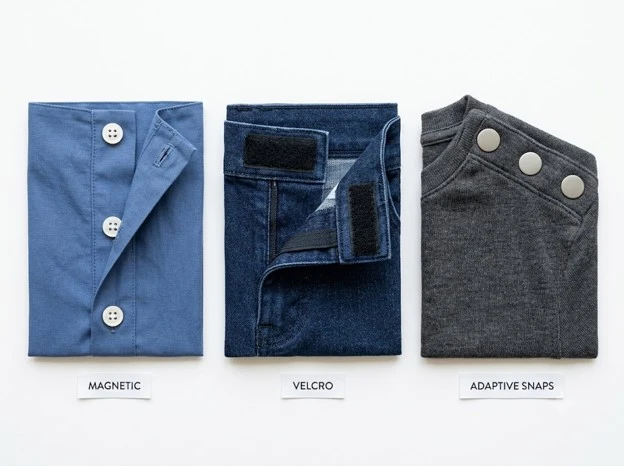
Every adaptive garment feature is able to fit into one of five categories of design. Knowing about these five categories is important in helping you decide if a certain piece of clothes really is adaptive or not.
The closure of any standard clothing item poses the most common problem when used by people who suffer from a disability. Buttons, zippers at the back, and hooks all require the user to use their fingers and hands properly, which many disabled people cannot do.
Adaptive closures include:
A design made for a standing body will not work for a seated body. This is not just a fitting challenge; this is an issue of structural geometry. When a person changes his or her position from standing to sitting, the ratio of the body changes – the back becomes elongated, the waistline moves, the lap gets filled with cloth, and many other changes occur. The standard cut of trousers for a standing person will acquire a huge back split at the waistline and pressure points on the seats and thighs.
Pattern modifications come into play with the following seated-fit engineering:
There is a large population of people living with disabilities who deal with treatments in addition to their day-to-day activities, like insulin pumps, port-a-caths, PICC lines, G-tubes, ostomy bags, catheters, and external defibrillator leads. The need to partially or fully undress is essential in order to gain access to these medical devices when wearing conventional clothes. However, specially designed clothes have built-in openings and pockets as well as strategic zip locations for accessing these devices without undressing.
People with different levels of sensory processing – which is often associated with autism spectrum disorder, ADHD, sensory processing disorder, and other neurologically-based disorders – find the feeling of the clothes touching their bodies an important matter indeed. Such issues as tags, raised seams, tight elastic, and certain fabric textures might become serious sources of discomfort or even disability, preventing a person from wearing this item of clothing, despite its fit and ease of dressing. The features of the adaptive design for such purposes include tagless design, flat-felled and bonded seams, natural or mixed soft fabric, seamless knits, and a lack of pressure creating elastic at the cuffs and waistlines.
There is also the issue of skin safety. Those individuals who spend much time sitting down and those who have decreased sensation due to some neurological disease face an increased risk of breaking the skin because of friction and pressure. The means to protect skin used in adaptive clothing design are flat seams that exclude the formation of friction ridges, fabric choice that prevents the retention of heat and moisture, and the absence of pockets and decorations in the back area.
Some people with disabilities dress independently with one functional hand or arm — following stroke, limb difference, or injury. Others dress with caregiver assistance. Both scenarios require garment designs different from standard two-handed self-dressing assumptions. One-hand-operable design features include closures that can be managed from a single point, wrap-style garments that lie flat and position easily, and garments without elements that require two hands to align simultaneously. Caregiver-assisted designs prioritize speed and comfort for both parties — lay-flat dressing, rear-access closures, and designs that allow dressing while the wearer remains in a chair or bed.
Adaptive Design Category Quick Reference
| Design Category | What It Solves | Key Features |
| Closure engineering | Standard closures require dexterity, grip, and range of motion many people with disabilities do not have | Magnetic, Velcro, snap, pull-on, open-back |
| Seated-fit engineering | Standard garment geometry does not fit a seated body correctly | High back rise, short front rise, no back pockets, side zips |
| Medical device access | Treatment devices require access without full undressing | Hidden pockets, purpose-built openings, discreet zippers |
| Sensory and skin safety design | Fabric texture, seams, and tags cause discomfort or skin breakdown | Tagless, flat seams, soft natural blends, no tight elastic |
| One-handed / assisted dressing | Standard dressing assumes two functional hands and independent standing | Wrap styles, side snaps, lay-flat design, rear-access closures |
Adaptive clothing caters to an array of individuals with different impairments, but the design focus changes dramatically depending on the impairment and the situation. Realizing this ensures you don’t make a common mistake in sourcing garments: picking a piece of clothing just because it has the adaptive tag and then finding out the features don’t fit the need.
The crucial design specification is seated-fit engineering, not closure type. A person using a wheelchair who has full hand mobility does not need magnetic closures; they need pants that fit properly while sitting, a jacket with proper back length so that it doesn’t ride up, and a side-zip closure that allows them to dress and have access for their catheter without transferring. The seated-fit pattern engineering is the engineering effort that will make the piece of clothing functional. If you want to learn more about this category, take a look at the articles about adaptive clothing for seniors and young adults.
Parkinson’s disease, Multiple Sclerosis, Cerebral Palsy, and Stroke each have their own way of creating difficulties with dressing. Tremor means no precise alignments are possible – magnetic closures are the universal answer. Rigidity of muscles slows down the process – fewer action clothes are the best solution here. Stroke causes unilateral weakness, and a one-handed-operable garment becomes necessary. Changing symptoms in MS dictate that the garment should work well on any day, from a good one to a difficult one. Closure engineering is usually the first adaptive category here.
As for Autism Spectrum, ADHD, and Sensory Processing Disorder, they have dressing problems, which are hard to notice from the outside. It is not about being physically challenged – it is all about being sensory challenged. The correct adaptive design for this group belongs completely to category four: no tags, flat seams, soft fabric, and no tight elastics. A garment without any adaptive closure solutions might become the right choice if standard closures are OK and the fabric and construction are good enough.
Limbs variations, either congenital or acquired, will need clothing that conforms to the body proportions of the individual concerned, will allow for any prosthetics used, and dressing using whatever functionality remains. One-handed dressing design will be pertinent to many individuals. Proportion and sizing can pose the main problem here, given that sizing assumes normal limbs proportion.
Medical appliance access will be the main concern of the third design type. Such an item can resemble regular apparel, but the difference lies in the hidden access point to make it functional for the person’s medical needs.
Steps to Determine the Suitability of an Adaptive Garment Before Purchasing
The adaptive tag does not automatically mean functional clothing. Determining whether or not the garment will indeed be usable for an individual must be done by going deeper than the label and matching up the garment with the five types of design described above.
This involves starting from the particular barrier in the process and then looking outward to find the feature, and not vice versa. If the barrier is button manipulation, the required feature is an alternative closing method: either magnetic, Velcro, or snaps. If the barrier is seated fit, the required feature is pattern engineering; again, this has no connection with closure.
Verify Function in Context
Closures that may seem simple to operate on a display table or in a photo are different when put to the test. Test magnetic closures with less grip or one hand. Verify that Velcro closes firmly without needing to apply steady pressure. Test seating comfort immediately upon putting on the garment — do not test standing up. Verify access to medical devices if you have one.
When dealing with sensory-sensitive individuals, make sure to ask for fabric specifications — what the fabric is made of, how the seams were sewn, and where the label is located. “Soft” is not enough of a description. The OEKO-TEX Standard 100 ensures the material has undergone testing for any harmful substances — this is important for skin-sensitive wearers or those wearing their garment daily.
The adaptive clothing undergoes wear that exceeds regular clothes. The fastening system, especially the Velcro and magnetic ones, must be tested for durability through several wash cycles. The laundry condition used in the care institutions must endure much harsher tests compared to those performed at home.
Adaptive Garment Evaluation Checklist
| Evaluation Point | What to Verify | Why It Matters |
| Feature-to-barrier match | Does the specific adaptive feature solve the specific dressing barrier? | Wrong feature for the barrier = garment does not function as adaptive |
| Closure operation in context | Can the closure be operated in the way the wearer will actually use it? | Table-test vs real-world use differ significantly for limited dexterity |
| Seated-fit geometry | Does the garment fit correctly when the wearer is seated? | Standing-cut garments reveal fit problems only when worn seated |
| Seam and tag construction | Are seams flat? Is the garment tagless or heat-transfer labelled? | Raised seams and tags cause irritation with extended daily wear |
| Medical access function | Does the access opening work with the specific device the wearer uses? | Pocket size, reach, and re-closure must be tested against the real device |
| Fabric specification | What is the fiber content and surface construction? | Generic ‘soft’ claims do not confirm sensory-appropriate specification |
| Wash durability rating | How many wash cycles are closures rated for? Home or commercial laundry? | Especially critical for care facilities — closure degradation is a cost issue |
| Aesthetic standard | Does the garment look like regular fashion from the outside? | Adaptive features visible to a casual observer indicate poor design integration |
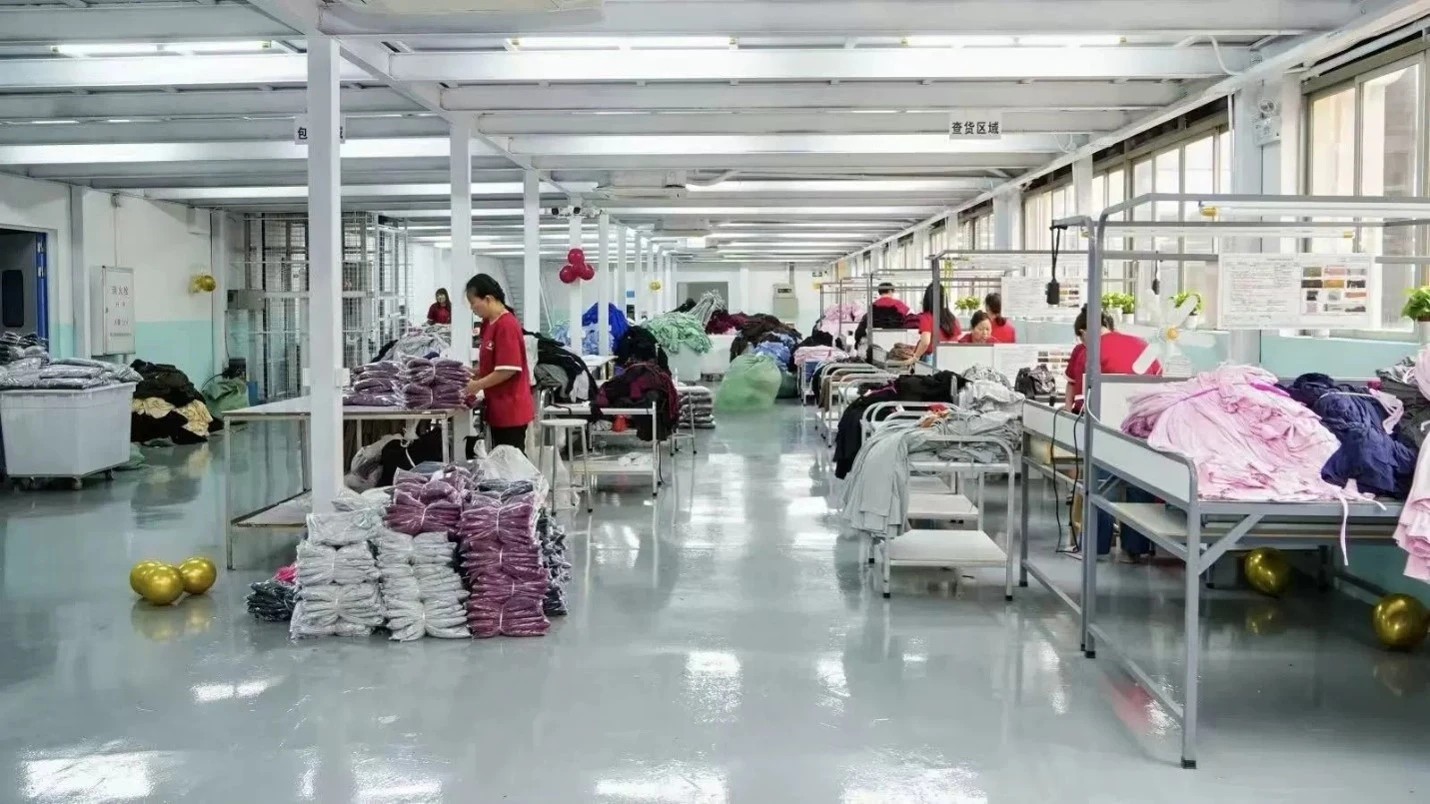
Adaptive clothing has come a long way over the past decade. Mainstream brands have made their mark on the field — proving that adaptations can easily be built into modern designs without detracting from style. It’s expected that the adaptive market will continue to see major growth all the way until 2032, spurred on by an aging population, increased awareness about disabilities, and the consumer demand for fashion that works for everyone.
However, there is still a gap. Mainstream adaptive lines focus on only a small selection of SKU options and aim for general access rather than special adaptation. The distinction between a piece of clothing designed to suit individuals with any kind of disability and one built for a full-time wheelchair user, or someone who suffers from severe tremors due to Parkinson’s disease, or an autistic individual with sensory sensitivity — that gap needs to be filled by more than just putting magnetic closures on a mainstream design.
Adaptive manufacturers specialize in fulfilling this gap by providing customized engineering of adaptive patterns, detailed fabric specifications, and full customization based on the type of closures, medical access placement, sizing, and manufacturing process. In cases where the buyers want to develop adaptive products on a large scale through their program, the specialized OEM model would provide such specifications without the need to develop the patterns in-house.
AdaptiveGarment.com develops adaptive clothes for buyers in the B2B segment worldwide. In this regard, the current design collection includes all the adaptive design elements, which are closure engineering, seated-fit patterns, medical device access, sensory-specific fabric options, and one-handed dressing designs. OEM manufacturing is done starting from 100 units per style, with full customization and three levels of documentation quality control process.
What is the main distinction between adaptive clothing and regular clothing?
Regular clothing is constructed for able bodies that can stand up, hold their arms above their heads, and use both hands to grasp and fasten closures in a traditional order. Adaptive clothing is created in order to eliminate certain barriers that prevent people with various disabilities from dressing themselves properly or comfortably. This is not always visible on high-quality adaptive clothes since the engineering is done inside, and the clothing appears regular.
Is every feature of adaptive clothing suitable for people with all kinds of disabilities?
No, this is the most crucial thing to remember about choosing the right adaptive clothes. There are five main design categories of adaptive clothes – closure engineering, seated-fit, medical device access, sensory design, and one-handed dressing – each addressing certain types of barriers. If someone uses a wheelchair and has intact hand function, then he or she needs only seated-fit engineering but no magnetic closures.
Use the criteria of design as follows: Does the closure mechanism operate in a way that the user will really wear it, with impaired grip, one-handed, or with trembling? Will the garment fit the user’s correct position – sitting, using a prosthesis, or with the exact body dimensions? Has the construction of fabric been described? Are the garment’s elements invisible? If you cannot answer positively to these questions, the garment has some design issues that marketing descriptions won’t solve.
No, and if it does, it is a sign of bad design integration. Good adaptive clothing for people with disabilities cannot be distinguished from ordinary fashion garments. Magnetic closures are indistinguishable from normal buttons. Trousers designed for a sitting position are indistinguishable from normally cut trousers. The zipper is sewn on the inside seam of the garment, but not on the outside. Tagless construction is, of course, tagless by its nature.
Adaptive clothes for self-dressing emphasize closures and designs that are possible to open by the user with their remaining functionality – use of only one hand, less ability to grip things, reduced range of motions. This design aims to make the caregiver unnecessary wherever possible. Adaptive clothes for assisted dressing put an emphasis on convenience and efficiency of use for both the user and the caregiver – easy-to-lay-flatten dress, closure in the back, large opening, and ease of dressing while the user is in the sitting position in a chair or a bed.
AdaptiveGarment.com provides specialized guides specifically for different demographics related to adaptive clothing. The guide for adaptive clothing for women discusses design considerations and sources for adaptive clothing that are appropriate for adult women with various conditions. The guide for adaptive clothing for seniors discusses the conditions that affect seniors most commonly, such as arthritis, Parkinson’s, dementia, and wheelchairs, and includes sections about sourcing from care facilities. The guide for adaptive clothing for young adults discusses the unique considerations for young adults who are in their late teens through their 30s, which include sensory considerations for neurodivergent individuals and condition-specific adaptive clothing for cerebral palsy and spinal cord injuries.
Looking to source adaptive clothing for people with disabilities at scale? AdaptiveGarment.com manufactures across all five adaptive design categories — closures, seated-fit, medical access, sensory fabrics, and assisted dressing designs. MOQ from 100 pieces. Get a free quote in 10 minutes: +8617702035343 or visit adaptivegarment.com/contact
